
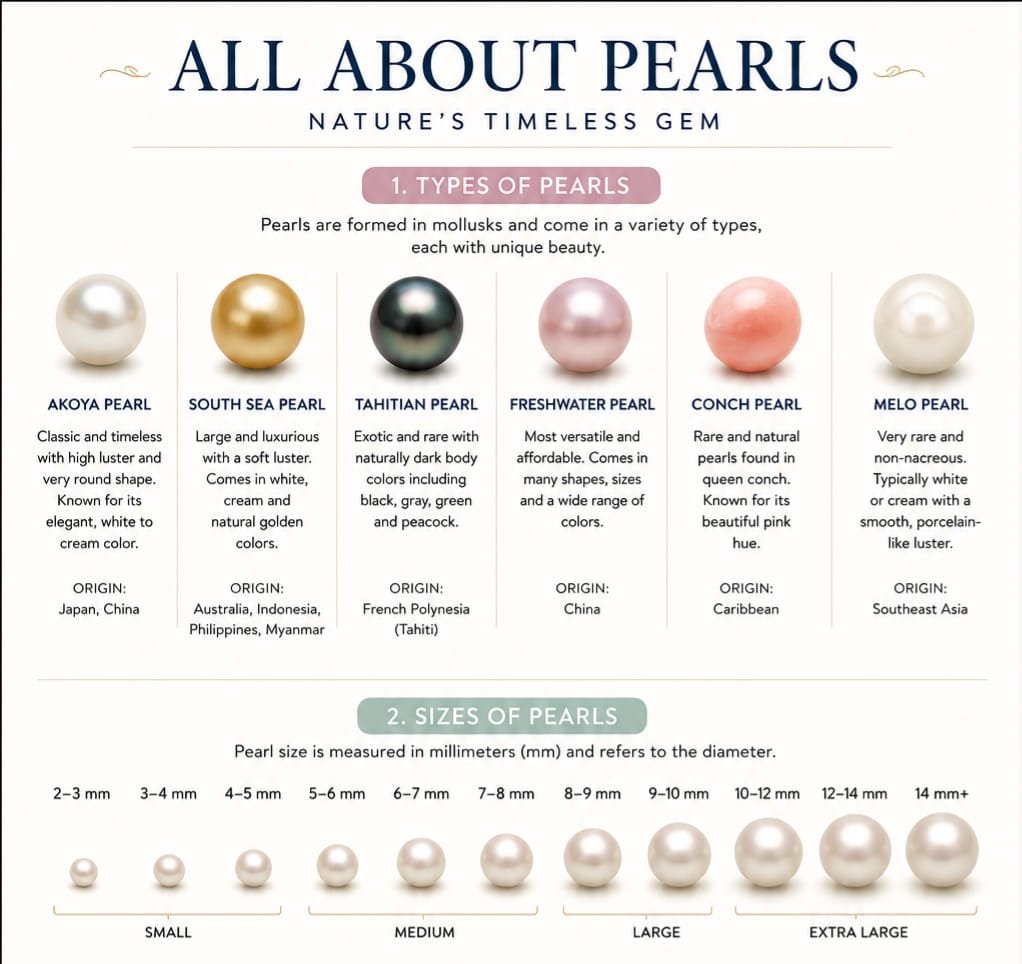

Pearls have been treasured for thousands of years, and they remain one of the most elegant choices for women of every age. But not all pearls are the same. They differ in where they are grown, their colour, their size and their price. This guide explains the main types of pearls, how to choose the right size, and how to care for them.
How pearls are formed
A pearl forms when an oyster or mussel coats an irritant inside its shell with layers of nacre, the same lustrous material that lines the shell. Over time, those layers build up into a pearl.
Natural pearls form without any human help. They are extremely rare today. Cultured pearls are real pearls grown on pearl farms, where a small bead or piece of tissue is placed inside the mollusc to start the process. Almost all real pearls sold today are cultured. Faux or simulated pearls are made from glass, shell or plastic beads coated to look like pearls.
The four main types of pearls
Akoya pearls
Akoya pearls are saltwater pearls grown mainly in Japan and China. They are the classic pearl most people picture: round, white or cream, with a bright, mirror-like lustre. They are usually around 6 to 9mm.
Freshwater pearls
Freshwater pearls grow in mussels in lakes and rivers, mostly in China. They come in the widest range of shapes and colours, from round to baroque, in white, pink, peach and lavender. They are the most affordable real pearls.
Tahitian pearls
Tahitian pearls come from French Polynesia and are known for their dark, exotic colours: grey, green, blue and the prized peacock shade. They are usually larger than Akoya pearls.
South Sea pearls
South Sea pearls are grown in the waters of Australia, Indonesia and the Philippines. They are the largest and most valuable cultured pearls, often 10mm and above, in white, silver and rich golden tones.
Pearl sizes: what they say about your style
Size makes a surprising difference to how a pearl looks when worn. Pearls around 5 to 6mm are delicate and understated, ideal for everyday wear and petite frames. Pearls of 7 to 8mm are the classic choice, elegant without being showy. Pearls of 9mm and above make a bold, luxurious statement for evening and special occasions. Many women over 40 find 7 to 9mm the most flattering balance of presence and refinement.
How to judge pearl quality
Jewellers look at a few things: lustre (how brightly the surface reflects light), surface (fewer blemishes is better), shape (perfectly round pearls are the rarest), nacre thickness (thicker nacre lasts longer) and, for strands, how well the pearls match. Lustre matters most: a pearl with a deep glow will always look beautiful.
How to tell real pearls from faux pearls
The simplest check is the tooth test: gently rub the pearl against the edge of your front tooth. Real pearls feel slightly gritty, while faux pearls feel smooth. Real pearls also feel cool at first and warm up slowly on the skin, and they tend to feel heavier. For certainty, ask a qualified jeweller.
How to care for pearls
Pearls are soft and sensitive to chemicals, so treat them gently. Put them on last, after perfume, hairspray and lotion. Wipe them with a soft, slightly damp cloth after wearing. Store them flat and separately so they do not get scratched, and avoid wearing them in the shower or pool. Faux pearls need the same care, because their coating can peel with exposure to chemicals. For more, see our jewellery care tips.
Enjoy the pearl look for less
If you love the elegance of pearls for everyday wear, fashion jewellery with faux pearls gives you the look at a fraction of the price. Our Elegant Pearl & Crystal Floral Brooch Pin and Elegant Gold Heart Pearl Pendant are easy ways to add a pearl accent to your outfit.
Frequently asked questions
Are cultured pearls real pearls?
Yes. Cultured pearls are grown by real oysters and mussels. The only difference from natural pearls is that a pearl farmer starts the process.
Which type of pearl is the most valuable?
South Sea pearls are generally the most valuable cultured pearls, because of their large size and thick nacre. Natural pearls are rarer still.
Can pearls get wet?
A little water will not harm them, but avoid showering or swimming in pearls, as chlorine, salt and soap can dull their lustre over time.
Follow Jewellery Online SG on Facebook and Instagram for more jewellery tips, styling ideas and inspiration.
[…] wear and occasions. Our Elegant Gold Heart Pearl Pendant is an easy place to start, and our guide All About Pearls explains the different […]